ECCV 2026
Layout analysis is still boxed into fixed labels and rectangles. DocLayout-VL reimagines it as a foundation-model problem: open-vocabulary layout parsing, tree-structured document understanding, pixel-accurate masks, and prompt-driven control in one model.
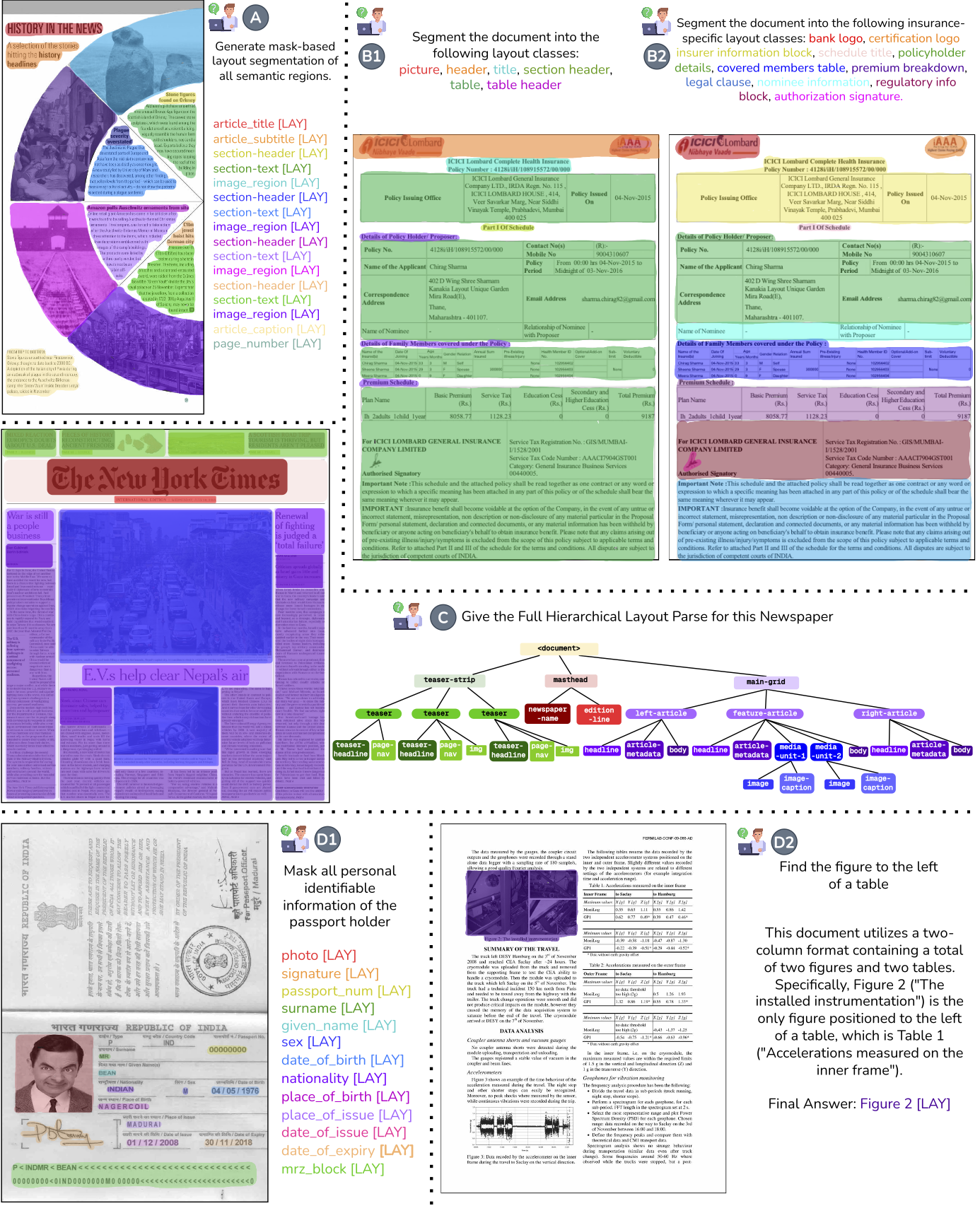
Document layout understanding has been stuck in a pre-foundation-model era: fixed ontologies, non-hierarchical labels, and axis-aligned boxes. That abstraction breaks exactly where real documents become useful: irregular regions, nested sections, domain-specific labels, curved text, and interactive user intent.
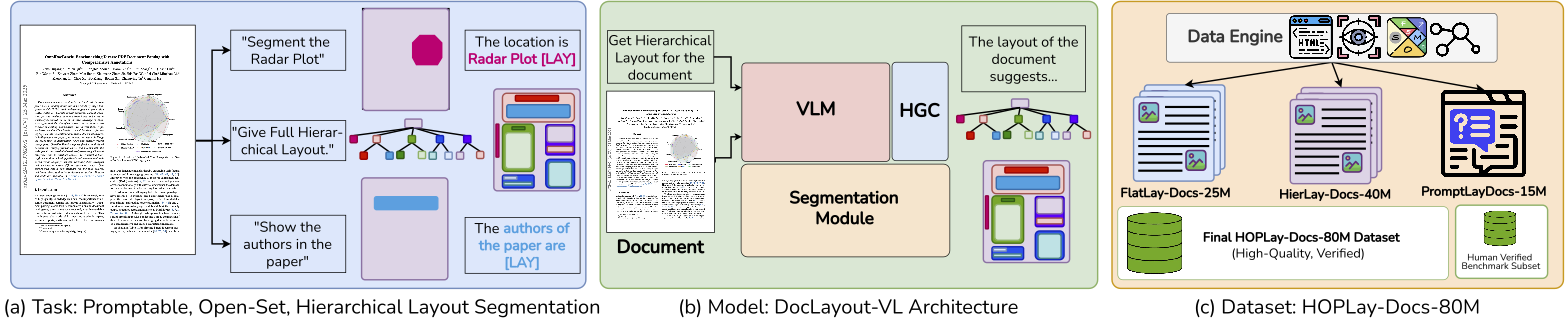
DocLayout-VL resets the formulation. It treats layout as contextualized, hierarchical, open-set, and promptable segmentation. For a page, the model predicts a coherent layout tree, assigns open-vocabulary semantic labels, grounds every node with a pixel-accurate mask, and can adapt the parse at inference time through natural language prompts.
At the center is the Hierarchical Grounding Contextualizer, which uses tree-aware attention over parent, child, and sibling relationships before mask decoding. Trained on HOPLay-Docs-80M and evaluated on HOPLay-Docs-Bench, DocLayout-VL moves layout understanding from static preprocessing to a controllable, semantically grounded interface for document intelligence.
Task formulation. Agentic document workflows need more than OCR and rectangles. They need a page representation that can be queried, revised, grounded, and composed across downstream reasoning steps.
Agents cannot reliably operate on coarse bounding boxes when documents contain curved text, overlapping regions, dense tables, or irregular graphics. Pixel-accurate masks give every extracted region a precise visual footprint, making redaction, retrieval chunking, citation, and verification spatially trustworthy.
Real workflows do not share one universal ontology. A financial report, medical form, slide deck, and government circular all demand different concepts. Open-set labeling lets the model infer domain-specific layout semantics instead of forcing every page into a small closed taxonomy.
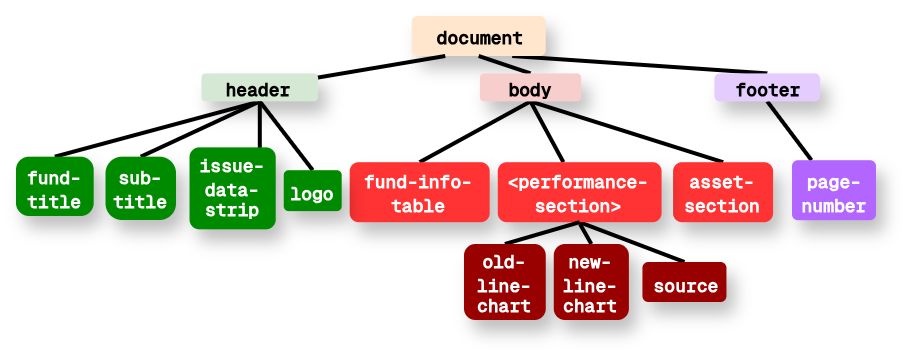
Document meaning is nested: sections contain headings, tables contain cells, forms contain fields, and panels contain subregions. A layout tree exposes these parent-child-sibling relations so agents can reason over context, reading order, containment, and multi-step extraction plans.
Agentic systems need to ask for exactly the layout they need: redact only PII, extract all invoice fields, isolate figure captions, or focus on a spatial region. Promptable layout understanding turns parsing into an interactive interface rather than a one-shot preprocessing artifact.
Watch DocLayout-VL generate a structured layout tree in real time. Each [LAY] token is linked to a
pixel-accurate mask that is revealed on the document image as the model streams its output.
DocLayout-VL
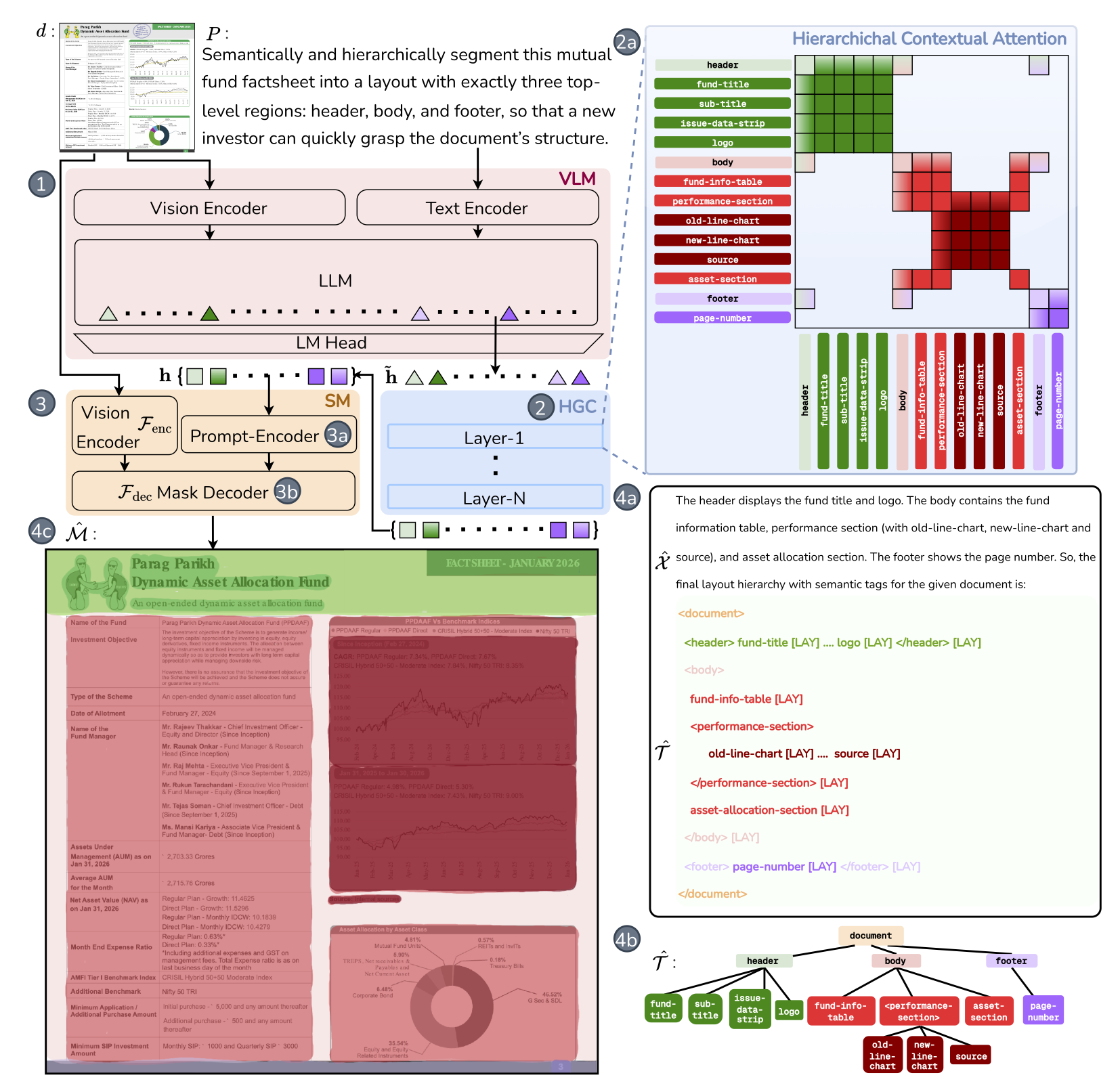
DocLayout-VL architecture.
A vision-language model generates a serialized XML layout tree with special [LAY] tokens. The
Hierarchical Grounding Contextualizer refines those tokens using tree-aware attention, and a segmentation
module decodes pixel-accurate masks for each layout region.
The VLM autoregressively produces a semantic XML-style layout tree, creating an editable structured parse rather than a flat list of detections.
HGC refines [LAY] token embeddings with tree-aware attention over parent, child, and sibling
relations, enforcing structural locality before mask prediction.
A segmentation module converts the contextualized layout tokens into masks, grounding every semantic node in precise page evidence.
Step through the full pipeline — document + prompt → VLM → Hierarchical Grounding Contextualizer (with its tree-aware attention) → Segmentation Module → masks, answer, and layout tree — in an animated, camera-guided walkthrough.
HOPLay-Docs-80M supports foundation-scale learning for flat, hierarchical, and prompt-conditioned layout segmentation. HOPLay-Docs-Bench is a human-verified suite for evaluating open-set, hierarchical, curved, and promptable layout understanding.
Open-set flat layout grounding with 25M regions and 250K unique labels.
Nested layout structure learning with 40M regions and hierarchy-aware supervision.
Instruction data for prompt-conditioned extraction, with 15M regions and 5M annotations.
DocLayout-VL turns the hardest layout capabilities into a single strong result: open-set semantics, hierarchy, curved regions, promptable control, and closed-set transfer without task-specific detectors. Select a benchmark and metric to explore every reported model comparison.
Flat, hierarchical, curved, promptable, and overall evaluation on HOPLay-Docs-Bench.
mAP@50:95 across ten established document layout datasets.